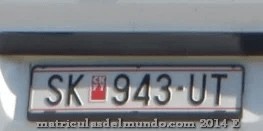
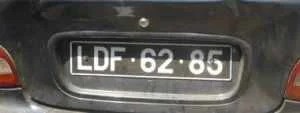
Yugoslav car license plates are currently obsolete and are theoretically invalid. Yugoslavian license plates were also used by Serbia and Montenegro later on. Yugoslavian license plates used plates with an elongated and reduced size, with black characters on a white background. The configuration of Yugoslavian license plates was two letters followed by four numbers separated in pairs. The first two (or three) letters identified the Yugoslavian region.
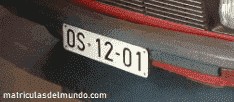
Yugoslavia license plates from 1961 consisted of a two-letter regional code, or less commonly three letters, the Yugoslav coat of arms (a red star), and two blocks of numbers separated by a hyphen. Initially, the configuration was two numbers and two numbers, later three and two, and finally three and three. In the case of more populated regions, higher numbers were used. The characters were black on a white background, which became reflective during the final years.


Yugoslavia license plates were used until the complete disappearance of this state in February 2003. During the 1990s, the transition was made from license plates displaying the red star to plates using the national flag (without the star). Until 2011, Serbia and Serbia and Montenegro continued using Yugoslav license plates with the national flag.

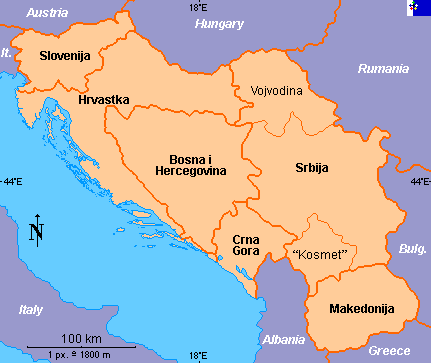
When the countries that formed Yugoslavia separated, the license plates that had been in use ceased to be valid and the entire vehicle fleet had to be re-registered to obtain new license plates. Each country became independent on a different date, so Yugoslav license plates remained valid until different years depending on the area. You can find more information in the section dedicated to each of the countries: Bosnia and Hercegovina, Croatia, Slovenia, North Macedonia, Montenegro, Serbia and Kosovo*.
Yugoslavia used a series of special license plates. Trailers had the regional code and coat of arms moved to the right side of the plate.

Temporary license plates used black characters on a white background, retaining the regional code but ending with the letters RP (Registrovano Privremeno) and the last two digits of the year in which the plate was valid. Previously, until reaching number 999, temporary license plates used a number to identify the region. On these plates, the letters RP appeared first, with a red strip below the year on the right side of the plate.


| Regional codes | ||
|---|---|---|
| 1-Bosnia Hercegovina | 2-Montenegro | 3-Croatia |
| 4-North Macedonia | 5-Slovenia | 6-Serbia |
| 7-Kosovo | 8-Vojvodina | |
Military license plates used a dark blue background and began with the letter M-Militia. The first number identified the region.

Agricultural vehicle license plates used a different size and configuration from the other special license plates. They used white characters on a green background. A serial number was displayed at the top of the plate and the name of the region, in capital letters, at the bottom. In the case of a trailer, the regional name was displayed at the top.

Since the beginning of the 1960s, Yugoslavia license plates used a two-letter code to identify the region. On some special license plates, this could be located elsewhere on the plate. In some cases, three-letter codes were created. In the table below, you can see the complete list of codes and the dates when they began or ceased to be used.
| Code | Region | Currently in: |
|---|---|---|
| AR | Aranđelovac | Serbia |
| BA | Berane Formerly Ivangrad Since 1998 | Serbia |
| BČ | Brčko | Bosnia and Hercegovina |
| BD | Budva | Montenegro |
| BG | Belgrade | Serbia |
| BI | Bihać | Bosnia and Hercegovina |
| BJ | Bjelovar | Croatia |
| BL | Banja Luka | Bosnia and Hercegovina |
| BM | Beli Manastir | Croatia |
| BN | Bijeljina | Bosnia and Hercegovina |
| BO | Bor | Serbia |
| BP | Bijelo Polje | Montenegro |
| BR | Bar | Montenegro |
| BT | Bitola | North Macedonia |
| BU | Bugojno | Bosnia and Hercegovina |
| CE | Celje | Slovenia |
| CT | Cetinje | Montenegro |
| ČA | Čačak | Serbia |
| ČK | Čakovec | Croatia |
| ČP | Čapljina | Bosnia and Hercegovina |
| DA | Daruvar | Croatia |
| DE | Delnice | Croatia |
| DJ | Djakovica | Kosovo* |
| DJK | Djakovo | Croatia |
| DO | Doboj | Bosnia and Hercegovina |
| DU | Dubrovnik | Croatia |
| GL | Gnjilane | Kosovo* |
| GM | Gornji Milanovac | Serbia |
| GO | Nova Gorica | Slovenia |
| GS | Gospić | Croatia |
| GV | Gostivar | North Macedonia |
| GŽ | Goražde | Bosnia and Hercegovina |
| HN | Herceg Novi | Montenegro |
| IG | Ivangrad Later Berane BA | Serbia |
| JA | Jagodina | Serbia |
| JC | Jajce | Bosnia and Hercegovina |
| KA | Karlovac | Croatia |
| KC | Koprivnica | Croatia |
| KG | Kragujevac | Serbia |
| KI | Kikinda | Serbia |
| KK | Kikinda Former | Serbia |
| KM | Kosovska Mitrovica Since 1993 Formerly TM | Kosovo* |
| KN | Krapina | Croatia |
| KNJ | Konjic | Bosnia and Hercegovina |
| KO | Kotor | Montenegro |
| KP | Koper | Slovenia |
| KR | Kranj | Slovenia |
| KŠ | Kruševac | Serbia |
| KT | Kutina | Croatia |
| KU | Kumanovo | North Macedonia |
| KV | Kraljevo | Serbia |
| KŽ | Križevci | Croatia |
| LE | Leskovac | Serbia |
| LI | Livno | Bosnia and Hercegovina |
| LJ | Ljubljana | Slovenia |
| LO | Loznica | Serbia |
| MA | Makarska | Croatia |
| MB | Maribor | Slovenia |
| MD | Modriča | Bosnia and Hercegovina |
| MO | Mostar | Bosnia and Hercegovina |
| MS | Murska Sobota | Slovenia |
| NA | Našice | Croatia |
| NG | Nova Gradiška | Croatia |
| NI | Niš | Serbia |
| NK | Nikšić | Montenegro |
| NM | Novo Mesto | Slovenia |
| NP | Novi Pazar | Serbia |
| NS | Novi Sad | Serbia |
| OG | Ogulin | Croatia |
| OH | Ohrid | North Macedonia |
| OS | Osijek | Croatia |
| PA | Pančevo | Serbia |
| PB | Priboj | Serbia |
| PD | Prijedor | Bosnia and Hercegovina |
| PE | Peć | Kosovo* |
| PG | Podgorica Since 1992. Formerly TG | Montenegro |
| PI | Pirot | Serbia |
| PK | Prokuplje | Serbia |
| PN | Paračin | Serbia |
| PO | Požarevac | Serbia |
| PP | Prilep | North Macedonia |
| PR | Priština | Kosovo* |
| PS | Podravska Slatina Slatina since 1992 | Croatia |
| PU | Pula | Croatia |
| PV | Pljevlja | Montenegro |
| PZ | Prizren | Kosovo* |
| RI | Rijeka | Croatia |
| RU | Ruma | Serbia |
| SA | Sarajevo | Bosnia and Hercegovina |
| SB | Slavonski Brod | Croatia |
| SC | Sokolac | Bosnia and Hercegovina |
| SD | Smederevo | Serbia |
| SI | Sisak | Croatia |
| SK | Skopje | North Macedonia |
| SM | Sremska Mitrovica | Serbia |
| SO | Sombor | Serbia |
| SP | Slavonska Požega Požega since 1992 | Croatia |
| SR | Strumica | North Macedonia |
| ST | Split | Croatia |
| SU | Subotica | Serbia |
| SV | Svetozarevo Jagodina since 1992 | Serbia |
| ŠA | Šabac | Serbia |
| ŠI | Šibenik | Croatia |
| ŠT | Štip | North Macedonia |
| TB | Trebinje | Bosnia and Hercegovina |
| TD | Titov Drvar Drvar since 1992 | Bosnia and Hercegovina |
| TE | Tetovo | North Macedonia |
| TG | Titograd Podgorica PG since 1992 | Montenegro |
| TK | Titova Korenica | Croatia |
| TM | Titova Mitrovica KM since 1993 | Kosovo* |
| TR | Travnik | Bosnia and Hercegovina |
| TS | Trstenik | Serbia |
| TU | Titovo Užice Užice since 1992 Later UE | Serbia |
| TV | Titov Veles Veles since 1992 | North Macedonia |
| TZ | Tuzla | Bosnia and Hercegovina |
| UE | Užice Formerly TU | Serbia |
| UL | Ulcinj | Montenegro |
| UR | Uroševac | Kosovo* |
| VA | Valjevo | Serbia |
| VI | Visoko | Bosnia and Hercegovina |
| VK | Vinkovci | Croatia |
| VR | Vranje | Serbia |
| VŠ | Vršac | Serbia |
| VT | Virovitica | Croatia |
| VU | Vukovar | Croatia |
| VŽ | Varaždin | Croatia |
| ZA | Zaječar | Serbia |
| ZD | Zadar | Croatia |
| ZE | Zenica | Bosnia and Hercegovina |
| ZG | Zagreb | Croatia |
| ZR | Zrenjanin | Serbia |
| ZV | Zvornik | Bosnia and Hercegovina |
From 1930 to 1942, Yugoslav license plates were slightly smaller and divided into two sections. On the left was a blue strip showing the regional code (banovina at the time) and the date until which the plate was valid, while on the right was a serial number in black on a white background (or white on black for military vehicles). It should be noted that at the time plates were issued annually and had to be renewed every year. The codes were issued according to the capital of the banovina, with 1 for Belgrade, 2 for Ljubljana, etc. At the end of the 1930s, the regional banovina code was replaced by a letter identifying the region. The letter c identified the banovina of Serbia.


This system with this design lasted until approximately 1943, when a different type of license plate came into use.
From approximately 1943 until the adoption of the system that remained in use until the end of Yugoslavia (see detailed section) in 1961, license plates featuring the red star for the first time were used. The blue strip on the left was replaced by a regional code followed by a number in red, the coat of arms (red star), and an independent numerical series for each region. The letter identified the region. For example, c identified Serbia. In the regions of Croatia and Slovenia, the first letter of the abbreviated regional name was also displayed in red.

Yugoslavia used a series of different international codes recognized and used by its vehicles. During the period of the Kingdom of Serbs, Croats and Slovenes, the SBS code was used. During the Yugoslav period, the Y code was initially used and was later replaced by YU. From 2003 to 2006, the SCG code (Serbia and Montenegro) was used.
The code YU identifies Yugoslavia. The license plates of Yugoslavia may be used with the international registration code YU next to it on the back part of the car.
Below you can find a car with the oval code and international recognition of Yugoslavia which is YU.
The international code YU identifies Yugoslavia, in Europe.
The country that uses the code YU on its car license plate system is Yugoslavia.. The letter or letters YU always identify Yugoslavia. The international code YU must always be displayed on the rear of the vehicle inYugoslaviaSpain in an oval in black characters on a white background when travelling abroad, except in very rare cases.
The date of the first car license plate registration officially issued in Yugoslavia was in 1906.
In Yugoslavia, you drive on the right side of the road.
Yugoslavia is located in the continent Europe. You can check how are the license plates of Europe following the link to the general section within matriculasdelmundo. Car license plates in Europe
In English, license plate of Yugoslavia is commonly called a license plate of Yugoslavia in the United States and Canada. In the UK and Australia, it’s often known as a number plate of Yugoslavia. Another term, registration plate of Yugoslavia, is understood globally and is slightly more formal. All these terms refer to the same vehicle identification plate of Yugoslavia, with usage varying by country. Car plate of Yugoslavia can be used in more technical situations.
Yes, both license plate of Yugoslavia and registration plate of Yugoslavia can be used to refer the same vehicle registration unique number of Yugoslavia.
Matriculasdelmundo. License plates of Yugoslavia. Reviewed and updated information. Matriculasdelmundo.com. Retrieved on 13/09/2026 from https://
Map of the Yugoslavia license plates
Copyright 2026 www.matriculasdelmundo.com
All the information about the license plates of cars and motorcycles in Yugoslavia and vehicle plates shown here has been extracted from official state archives (such as the BOE and the DGT in Spain), from personal sightings, by contacting automobile clubs from other countries, or through media or files referenced in the text. This information on car and motorcycle plates in Yugoslavia has been collected since 2009, so we hope you find the information you're looking for about Yugoslavia license plates.
😊 You can send us your comments and photos via the form or email us at matriculasdelmundo@gmail.com, and we will be happy to respond.
Copying, either in whole or in part of the information displayed on each section of matriculasdelmundo is prohibited, except in specific cases and with the site's administration's permission.